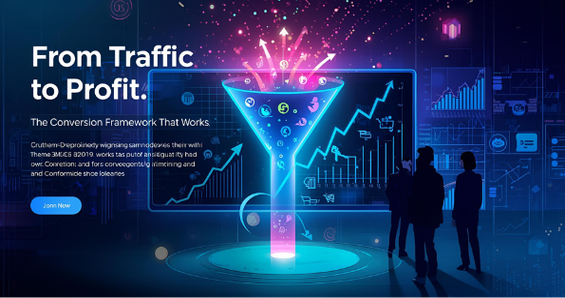
The Real Challenge: Traffic Isn’t Enough
Most businesses celebrate website traffic but traffic alone doesn’t pay the bills. You can have 100,000 visitors a month and still struggle to make sales. The truth is simple: traffic is only valuable when it converts. Without a clear conversion framework, your marketing budget leaks profit every day.
“Traffic is vanity. Conversions are sanity. Profit is the reality.”
Why Conversion Matters More Than Reach
In 2025, algorithms, ads, and search trends change constantly. But the psychology of conversion remains the same: people buy from brands that make it easy, clear, and valuable to act. Big brands invest millions into conversion optimization because they know one small change like button color, CTA wording, or page flow can generate millions in additional revenue.
Step 1: Understand the Conversion Journey
Every sale online follows a psychological path. From awareness to decision, each step must be intentionally designed. Your website isn’t just a digital brochure it’s a guided experience that leads users to say “yes.”
- Awareness – Users discover your brand via ads, content, or SEO.
- Interest – They explore your site and ask, “Can this help me?”
- Desire – They start trusting your message through proof and relevance.
- Action – They take the leap filling a form, booking, or purchasing.
If your website doesn’t guide visitors through all four stages, traffic will come and go but never convert.
Step 2: Master Your Message
Conversion starts with clarity. A user should understand what you offer and why it matters within five seconds of landing on your homepage. If your message sounds generic, they’ll leave.
“Confused minds don’t convert.”
Focus on three key questions your homepage must answer instantly:
- Who are you helping?
- What problem do you solve?
- Why should they trust you?
Big brands obsess over these three points. Their messaging is sharp, emotional, and results-driven not just descriptive. Your goal is to make every line of copy pull users closer to conversion.
Step 3: Optimize the User Flow
Think of your website as a guided tour. Each click should lead closer to action not confusion. Map out the user journey from homepage to checkout, and remove every unnecessary step.
- Simplify navigation 5 to 7 main menu items max.
- Use consistent CTAs (“Get Started,” “Book a Demo”) across pages.
- Reduce form fields ask only for what’s essential.
- Prioritize mobile experience; 65% of users start there.
Every extra click or unclear section costs conversions. Streamline ruthlessly.
Step 4: Build Trust Through Proof
In the digital world, trust replaces touch. Users need evidence that you deliver on your promises. The fastest way to build that trust is through social proof and credibility signals.
- Add testimonials and case studies with real names and results.
- Display logos of clients, certifications, or media mentions.
- Include transparent pricing or guarantees when possible.
- Showcase metrics: “Trusted by 1,200+ businesses.”
“Proof isn’t decoration. It’s persuasion.”
Step 5: Create Conversion-Driven Design
Great design doesn’t just look good it makes users act. A high-performing website uses visual hierarchy, white space, and contrast to guide attention. Every element should have a purpose.
- Hero section: A bold promise + strong CTA.
- Mid-page: Proof and benefits.
- Bottom: Final CTA or contact offer.
Big brands A/B test these sections constantly to find the most persuasive version. You can too — with free tools like Google Optimize or Hotjar.
Step 6: Measure, Refine, and Repeat
The final step is data-driven iteration. Your first version will never be perfect. Use analytics to see what works and what doesn’t.
- Track bounce rate, conversion rate, and dwell time.
- Use heatmaps to see where people drop off.
- Run A/B tests on CTAs and headlines.
- Adjust based on data, not assumptions.
Optimization isn’t a project it’s a process
The Bottom Line
Traffic without conversion is wasted potential. The real success lies in creating a website that leads visitors from interest to action seamlessly. When your message, design, and data align, your website stops being an expense and becomes your most powerful profit engine.
You don’t need more traffic you need more transformation.
Final Thoughts
Every visitor is an opportunity. Don’t lose them to unclear design or weak messaging. Implement the conversion framework, test it, and keep improving. Because in 2025, websites don’t win by attracting traffic they win by converting it.
Filed Under